Showing posts with label Studio paintings. Show all posts

Wednesday, February 18, 2009

Flowers in Landscape

These are two studio paintings that I did around Christmas. I left them hanging when my Mom passed away in early January and never got around to getting photos and posting them.

It's fun sometimes to try several approaches on a theme. To play with different ideas without trying to cram it all into one piece.
Here I was playing with a similar subject and colors but with different approaches and designs. For example, the top one has a big mass of the tree on the left and the bottom piece has the large mass of the tree on the right. The road painting has some visible sky and the field painting does not.
The road leads the viewer into the painting on the top, which is a pretty standard way to lead the viewer into a painting. In the bottom one, I tried to lead the viewer in with just color and brushwork. I am hoping that the eye is attracted to the area of the branches on the right and beyond into the field. Then, over to the far tree on the left and into the foreground again by the light pink flowers on the left. I am curious to hear if that is the path that others eyes are drawn to in that piece.


"Road with Flowers", 14" x 18" oil on linen, Frank Gardner © 2008
$1,300. Framed. Available at Galeria Gardner


"Field of Flowers", 14" x 18" oil on linen, Frank Gardner © 2008
$1,300. Framed. Available at Galeria Gardner

Tuesday, July 1, 2008

"Saint Paul's"

Commissions can be hard because you are dealing with trying to paint someone else's idea. Even if the clients are as easy going as mine were on these paintings, you worry if they will like what you come up with. You worry if they have an idea of what they want and you may not even come close. Do you have things that you ask or ways that you go about balancing the clients idea with your artistic integrity?

The request was to paint the local Episcopal Church, Saint Paul's. I must admit, it is not the most interesting church facade in town to paint. It is kind of an odd pink and the client did not really like pink. Aside from that, they left it to me as to size and composition.

To work out my ideas I started with several pencil studies. Just simple value plans trying to work up an interesting design.
From there, I took the one that I thought showed the most promise and did a small oil study to work out color and alter the composition just a bit. I was combining two photos to get the design I wanted. Sometimes combining two photos can be harder than just using one.


"Saint Paul's Study", 6" x 8" oil on board, Frank Gardner © 2008
Private Collection

Looking at the small study, I felt that the facade was too pink. The pink that the client did not care for, and that the whole thing needed to be warmed up a bit. My idea was to stick to cooler colors for a calming mood. so to warm it up I switched to a burnt sienna toned canvas.
By letting some of that show through, I could use the same cooler, calming colors, and achieve a warmer, more inviting result.

Thinking that some of you might be interested in how I went about this one I snapped a photo after I blocked in most of the shadow colors. There is only one light family color, the light green to the left through the branches. I tried to link most of these shadow colors into one big design with a center of interest around the doorway. There is a general mid value shadow color and a few darker accents.


"Saint Paul's" in progress, 14" x 18", Frank Gardner © 2008

Next, I cut the silhouette of the church, doorway, architectural details of the door frame, sunlit grass, sky holes in the tree, with the light family colors. I spent some time adjusting back and forth between shadow and light colors after that, but the main job was done. The tweaking was to soften edges, adjust colors, cover the tone of the canvas where it was distracting. With a canvas toned with such a strong color you have to be aware that those orange bits are going to draw attention. If they are too many left in the wrong places it can really mess you up. If you get too picky and cover too much, you've lost what you were trying to achieve by using it in the first place.


"Saint Paul's" , 14" x 18" oil on linen, Frank Gardner © 2008
Private collection

Here is the finished painting.
I am happy with how this one looks along side "Good Company". They may or may not hang near each other, but they are the same size and the large trees and the way they are painted tie them together nicely.

Friday, June 13, 2008

"The Lobster Pot"

The Lobster Pot Restaurant is one of my favorite Provincetown landmarks.
This painting was done from a photo reference on one of the rainy evenings during my trip to Cape Cod. I had really hoped to get back to Ptown to do some street scenes, but the weather kind of went sour on us. That should not have kept me from painting outside, but we just were not up for getting wet in a cold rain.
I need an umbrella.
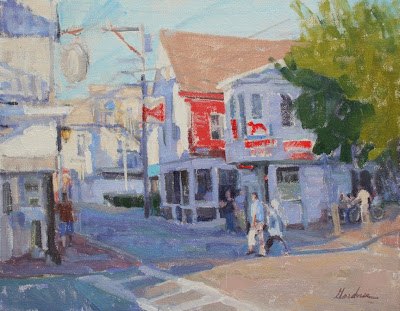

"The Lobster Pot", 11" x 14" oil on linen, Frank Gardner © 2008
$950. Framed. Available at Galeria Gardner
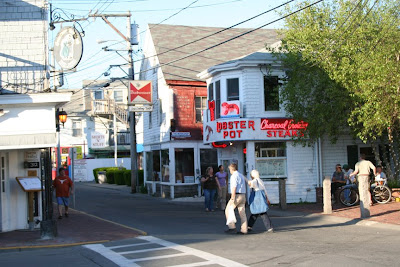

Reference photo for "The Lobster Pot", Frank Gardner © 2008


My friend Jack Riddle was talking about painting from photos on his blog the other day and suggested that I might write a few of my thoughts about that.

Here goes.

I always feel like I am taking a big risk when I post the reference photo next to my painting or a photo of the scene with the painting. Will all of my "mistakes" stand out like sore thumbs.

There are so many things to consider when using a photo reference. I could go on and on about pros and cons. One big con is that the values are usually a bit off. The darks are too dark and or the lights are too light and washed out. One pro is that it does not move and the light does not change, but that can be a con too.

Something I take into consideration when working from a photo is the look and or feel that I am aiming for in the finished piece. How much detail will I try and put into it. The problem with working from photos in the studio is that you can just keep going and going, adding in every little thing until it is really tight and probably over worked. It becomes a matter of taste and style.

The look that I decided on for this one was a solid design with a loose plein air feel. This was a plein air trip after all, and I wanted this painting to fit in well when hung together with the rest of the stuff from the trip.
I'm sure that this scene would look just as good if I had done a tighter job and brought it up to a more detailed finish, but that is not what I wanted in this particular painting.
By solid design I mean a strong pattern of light and shadow. Little details that are not real important can be edited out. Kind of like when I am plein air painting. Get the basic light and shadow pattern down first, add variety of color to the large value pattern, work up the detail in the center of interest. Get the important stuff down first, and then you can stop at any point.

The first thing that I did was evaluate two photos that I had of this street scene and chose the one that best suited my needs. I wanted the Lobster Pot to be the main interest, but the people are also an important part of Provincetown, so I wanted to feature them too. Couples walking, someone with a bike, that is all part of what makes it real. I liked having the building on the left to frame the street, but I did not want to add detail there that would take away from the Lobster Pot.

The neon sign is such an icon. I wanted to show it, but I did not want so much detail in it that it would hold the eye and not allow for movement in the painting. What I tried to get was the color and glow without even putting in any letters. It was one of the first things that I painted in. Almost pure cadmium red, thin enough to get the glow from the white tone of the linen showing through. Then I concentrated on just blocking in all of the shadow colors. I wanted to keep them lighter than what I was seeing in the photo. I tried to get a lot of variety in my colors but keep them all in a simple value range. I wish that I had taken some progress shots to help explain how I went about this.

Since I had determined that this would be a loose piece, working fairly fast was key. I approached it as if I was standing there on the corner trying to catch the important stuff first and fast. The big picture. When you see the reference photo along with the finished painting, it is easy to pick out little things that I did not include or may have drawn a little off, but is that detail important to the statement as a whole? Not for ME in THIS painting.
I'll try and point out a few examples of what I mean by lack of detail. Take a look at the budweiser sign. Did you know that it was a bud sign without having the words written out? O.K., my lobster may look a bit like a little red dog, but I bet that anyone that know Ptown knows that it is the lobster Pot. How about the tree? There could be a lot of picking at that and spotty leaves painted in, but the simple light/ shadow pattern works good enough in this case. The two figures in shadow walking in front of the restaurant. Can you tell that is two women? or at least feel the gesture of two figures walking casually? Good enough then. I think that the storefront windows behind them has just enough detail to know there is something in the window. When you stare at a photo you may be tempted to put in more and more in a thing like that.

I did not start adding any light family colors until I had a solid drawing down of color in shadow and most of it all linked together into a big pattern. Then I quickly laid in the light family colors. I put them in thick and then even scrapped some back off because texture always comes forward. I left the thicker stuff for the foreground and mid ground. I really had to rein in my urge to keep adding detail at this stage. My natural tendency is to make it all perfect. I wanted this to look like it could have been done on location in one go, so I stopped while I thought it still looked fresh. Could I have done some things differently? Sure. But each painting has to be thought of as an expression of your feelings. This is how I felt about it on this day. If I did it again today I might have a totally different set of colors and criteria.

That's all I'll write on my thoughts on this piece, and painting from photos for now. I'll probably end up expanding on this in the comments anyway. Thanks Jack for thinking that I might have some skills to share here. I'll work on some other posts along the same lines.

If anyone is still reading at this point, thanks.
I usually don't write such long winded posts.

Thursday, May 22, 2008

"Church View"

You may have figured out where this wall that I have been painting the figures is, if you looked at one of the first posts on My Paint Box. It is at the end of this side street in Atotonilco.

In this painting, and this one, I wanted the figures to stand out against the simple design of the street and walls, so the church is left out. In "Church View", the church is the subject, not just the figure. There is a little more detail in this painting than in the sketch. I wanted to emphasize the beautiful design of the church, however a lot of the detail is still suggested.
This painting is based on a plein air piece that I did during my last workshop.


"Church View ", 11" x 14" oil on linen, Frank Gardner © 2008
Private Collection


Plein air sketch, 8" x 10" oil on linen, Frank Gardner © 2008

I was happy with most of the painting done on location, but the design was rushed, and ended up being too cramped at the top. I had to squash down the main dome of the church to make it fit. Otherwise it would have run off the top of the panel just a bit, and that would not have worked design wise either. I thought about trying to fix this plein air, but it just could not be adjusted. It was easier to re visit the idea in a new painting. The sketch will not be for sale. It is one of those that are just a learning experience, good for use in the studio. Some of the proportions I corrected with the help of a photo. The values were off in the photo, so I followed the sketch on that.

Friday, May 16, 2008

"Thorns"

This wall in shadow is a nice setting to isolate this solitary figure against.
It's the same place as in this painting.


"Thorns", 8"x 10" oil on linen, Frank Gardner © 2008
Private Collection

This guy is carrying thin branches from a mesquite tree. He will bend them, while they are still green and pliable, into crowns of thorns. Then dry them.

You may wonder why a lot of the figures in my paintings are walking away. I think that it ads to the movement by having them walking into the scene as opposed to out of it at me. That would be a much more static pose. Most of the time I would rather have the viewer being led into my painting.

Friday, May 9, 2008

"Hard at Work II"

You may remember this composition from Another Grab Bag Palette. This one is the same design, larger canvas, and back to my normal palette.


"Hard at Work II", 14" x 18" oil on linen, Frank Gardner © 2008
Private Collection

What I was really missing in that grab bag was yellow. Now I was able to paint the yellow flowers along the back and the yellow bag. The first version really helped me get the design and drawing down. Working in series is always a good way for me to stay loose. I knew I had the other, so I was able to take some chances on this one. I did not feel like I needed to get into too much detail.


Detail, "Hard at Work II" , Frank Gardner © 2008


Detail, "Hard at Work II" , Frank Gardner © 2008

Tuesday, April 29, 2008

How Long Did it Take You to Paint That?

Last week I was able to get lots of quality painting time in the studio. There are some larger canvases in the works and a few small ones. I took a break from blogging so I could concentrate on the paintings and do some family stuff this weekend.


"Another Dusty Road", 30" x 40" Oil on Canvas
Frank Gardner © 2008
Private Collection


I have been working on this painting off and on for about a year and a half. That is about as long as I have ever worked on one piece. I had done a 14" x 18" painting of this scene two years ago and thought that it would make a great larger painting. This one started out strong and then I ran into some trouble. I moved some things around a bit, struggled with the light, etc. etc...It just wasn't looking how I could see it in my mind.
I decided to set it aside for a while and just live with it in different spots around our house. It has been back up in the studio several times over the past 18 months. Sometimes it came back downstairs looking worse than when it went up. Other times it came down looking better, but still needing a little work. After the talk about finish in my last few posts, I decided it was time to wrap this one up.
The first painting sold right away, so I did not have it around while painting the large one.


"Dusty Road", 14" x 18" Oil on Board, Frank Gardner © 2006
Private Collection


It is hard to keep a painting looking fresh when you need to keep making adjustments to get things looking how you want. I think that just walking away from this one once in a while kept me from overworking it. It is in a frame now and looks good. I may need to tweak just a few things now that I see it down at the gallery and posted here.
I like certain things about the small version better and some things about the larger one better.
The jury is still out on this one.

Tuesday, April 22, 2008

WIP - The Finished Painting

"Put your brushes down and step away from the canvas"
The voice echoed in my head like a cop on a loud speaker.
"Who, me? Just one more thing."


"Untitled" , 24" x 30" oil on canvas, Frank Gardner © 2008
$3,100. Available at Old Town Gallery, San Jose del Cabo

With some painting time at home this weekend and yesterday, I was able to finish the work in progress (WIP) from the other day.
I shouldn't post WIPs.
This is the post with the first stages.

Oh, I also struggle with titles sometimes. I'll post a title for this piece soon. Can't think of an appropriate one right now.

Monday, April 21, 2008

"You can never achieve perfection" Emile Gruppe

So how does one know when to stop?
I often tell students that I would rather see something painted slightly wrong, but with confidence, than something painted to perfection but with a look of labored fussiness. It's just that I don't always practice what I preach.

There were a lot of really great comments and thoughts on my last post. Thanks to everyone for sharing your thoughts and opinions on this. I'd like to borrow a few bits and pieces from all the comments to share here.

"Fuss over the details."
"messed up something that was just fine."
Seems like a lot of us have been there, done that.


"Second Wind, Spruce Head", 11" x 14" oil on board, 2008
$950. Framed, Available at Galeria Gardner

Stepping away from the piece to come back with fresh eyes seems to be a common way to try and control the urge to over work.

Speaking of which, here is the other Maine painting that I started last October, but just came back to with fresh eyes to make a few adjustments. It is of the same boat, "Second Wind", that I wrote about before. Some old wooden lobster boats in Maine have a sail in the back that allows the captain to do all of the labor by himself. Steer and haul pots. Amazing! He is swinging into the same dock as in the last post to unload his pots at the end of the season.

O.K., back to the main point. I told you I get distracted.

Seeing the finished painting in your mind, before you start, is also a good idea. You need to have some sort of idea of what you want to achieve right from the get go.

Here is a good quote by Emile Gruppe, from "Gruppe on Color".

"When I paint outdoors, I've always liked to let the paint do some of the work. I go for the big effect; and when I get it, I let the rest go. Of course, I can still remember my father telling me "try taking it a bit further." But I always felt that if I did, I'd ruin the spontaneity and excitement of what I had in the first place. After all, it's possible for a thing to be well drawn and so systematically developed that the essence of the subject is lost.
Here's the important difference between tight and loose painting: tight, meticulous work can be copied- even a reasonably clever student could do it. But loose, spontaneous work is full of accident and inspiration. And great paintings done in this manner can never be duplicated- the painter himself doesn't know how he got some of his effects. All he knows is the he was outdoors. Something happened to him. He saw differences; he felt the shadows and the textures- and put them down. Such painters see their pictures even before they begin them- as if in a dream. The subject hits them hard. When they finish, the picture is better than nature, but never as good as what was in their minds eye. They worry about it, of course- but they also know that you can never achieve perfection. There's never and end to things. It's like the universe: where do the stars end and heaven begin?"


Two more things that I pulled from the comments on the last post.

"Wasn't it Picasso who said, "A painting is never finished--it simply stops in interesting places." "

"Everyone else has to judge the painting without the benefit of our internal dialogue and the hindsight of seeing the better versions that happened before we finally stopped."

Very good points.

I think that in the end you just have to be happy with where you leave off on the painting. If I am not 90% satisfied with how the piece looks I will cull it out and not frame it and show it. That 90% is an estimate. I shoot for 100%, but I realize that I sometimes have to settle for a little less.

That's it for now.
Thanks!

Sunday, April 13, 2008

Work in Progress on a toned canvas

Back to my normal palette of colors for now.
I started two 24" x 30" canvases this weekend. For this painting I thought that a neutral gray toned canvas would work best.
I took all my leftover paint from the first start, added a little more red and yellow to get it warmer, thinned it a little, and toned this canvas.
Another great way to get this neutral toned canvas is to have a failed painting attempt and wipe it down.


The toned canvas was my mid tone. I started painting with my lightest lights, an off white on the warm side. I worked the negative space around the figures legs to get them positioned. The highlights on the hat and the scarves are enough to get the image to read. Then I sketched in a few lines and shapes of a darker tone. There you go, my main value pattern with a light, mid tone and dark.


I did not want to get into too much detail too soon. I am just putting down value notes and adjusting my drawing with paint as I go, working all over the canvas to avoid getting bogged down with the details. I pull the big shapes out first, trying to capture the gestures of the figures. This needs to be accurate before I can start to finish with details. I need to have the framework down so I can lay the details in with confidence in the right spot and leave them.


I continue to make slight value adjustments and begin adding more color. I make some adjustments to the gestures of the figures. I moved the arm up on the woman in the middle. I also moved the right shoulder of woman on the left just a bit to make her look like she is carrying a heavier load in that bag. I have not put the highlight back on there yet.
This is where I had to stop. I hope to wrap this one up before long and post the results.

Wednesday, April 9, 2008

Another Grab Bag Palette - "The Painting"

This painting was done with my second Grab Bag Palette. These colors were a bit harder than the first Grab Bag Palette that I picked last week. My colors this time were Raw sienna, Winsor Violet, Permanent Green Light, and Oxide of Chromium, plus White.


"Hard at Work", 8" x 10" oil on linen, 2008
Private Collection


I have a larger painting of this scene in the works, with my normal palette, but I wanted to give this one a try with the limited palette colors that I picked.
This gentleman was plowing his piece of this field while his wife walked along dropping corn into the rows. I usually don't take photos of people up close like this without permission. I asked this couple if I could shoot some photos to use for paintings, and I paid them for the privilege.

Friday, April 4, 2008

Grab Bag Palette - "The Painting"

If you did not read my intro to the Grab Bag Palette, see here.
This one was fun. I was able to get much better color than I had feared when I picked my tubes. Purple Lake was out, so I had Magenta, Terre Verte, Cerulean Blue, Chrome Yellow and White.
Mixing lots of colors first, like I showed in my last post, was the way to go. That way I knew what I could do with what I had.
After making the value board, I scraped what was left into three piles of "mud" that were helpful to me in the painting.


My palette, with a lot of the colors that I will use in the painting, pre mixed. They are reflecting a lot of blue sky since I shot this photo in the shade.
That is some liquin in the bottom right corner of the palette.
The thing with an odd limited palette like this is that the mixes need to be seen RELATIVE to the other colors that you will be painting with. Perfect place for pre mixing some colors.

Below is the finished painting and a detail.


"Team Work", 6" x 8" oil on board, 2008
$500. Framed, Available at Galeria Gardner


Detail of "Team Work"


We are going to a Camp Out / Birthday Party for one of my daughter's friends tonight and tomorrow.
Have a great weekend.
As always, thanks for stopping by.

Thursday, April 3, 2008

Grab Bag Palette - "The Grab"

Today I painted with colors that were chosen blindly, at random, from a box of paints that I had not used in a long long time. The exercise is suggested by Kevin Macpherson in his book, "Landscape Painting Inside and Out". He suggests setting aside all of the colors that you normally work with, and pick three to five random colors from twenty or thirty tubes of what is left of your paints. I had about twenty in an old paint box. You then have to do a painting with JUST those colors, plus white, no cheating.

Kathryn Law has been doing some paintings like this on her blog here, here and, here. We were swapping comments the other day, and I decided that I would give it a try. I told her I felt like I was about to jump into a lake where I knew the water would be really cold.

The colors I chose were Purple Lake, Magenta, Terre Verte, Chrome Yellow, and Cerulean Blue. I limited myself to five grabs, but one was an un marked tube that contained French Ultramarine Blue, which is a color I use all the time, so it was out. I also chose two tubes of Terra Verte, so I dropped one of those as well.
Gotta give myself some kind of chance you know.
The Terra Verte must have been from the days when I was still looking for the perfect tube of green. I tried em all. They all stink. Throw out your greens and just mix them. Terre Verte is stupid. It has no tinting power at all and I had to put tons of it into my mixes to change anything. Cerulean Blue is not far behind in tinting strength and it is not my favorite blue. My Purple lake was from so long ago that it was very dried up. I could not mix with it. Another one down. There went my darkest dark. Magenta is almost the same color though, not quite as dark and a little redder. It was going to be my "red". Chrome yellow was the lucky draw of all of them. I would have been sunk without it. The white was a given, so there I had my Grab Bag Palette. I was not that excited.


The grab, with piles of gray "mud" that were left over after some practice mixing.

I decided to see what they could do, you know, take them out for a test drive. I just mixed as many colors as I could come up with until my palette was full. Then, for fun, I layed them on a 6x8 board like my "Value Board" that I talked about in this post.
I had a ten step black and white value scale that I made with my workshop painters. The values were arranged along the edge of the board . I tried to line up the colors that I mixed using the new colors, by value, next to what I judged to be the value of each mix. This is actually a valuable exercise on seeing value. I also found that I was able to get a lot of good colors. That water was warming up.


In photoshop, I switched it to black and white to see how I did. There are some that are obviously off, but some were right on.
You may want to open another window and view the two enlargements side by side to compare. I am not an expert in photoshop or I would have put them together for you.


I finished the painting.
I'm working on getting a post together so I can share it with you all.

Friday, March 28, 2008

"Trees Along the River" - pre mixed palette

Here is another pre mixed palette and painting that I did this week.
I really liked the scene for its feeling of tranquility. I pushed the painting past the initial block in stage so I could layer the color a bit.
Barb Pask asked me to include a reference photo with one of these posts, so I added one at the bottom. I moved the composition around just a little.

I don't have a set number of colors that I mix up, although for the class I ask everyone to mix at least between 7 and 11 different colors. Sometimes you can get away with less. In this one I have more.
I'll often pick a color and mix it, then push part of that pile a little toward some other colors, say bluer or greener etc...but keep them in the same value. Then paint those three or four colors into the same mass to add some variety. The better you get at looking and seeing color, the better you will get at making those subtle mixes.
One of the main things that this exercise does is get you looking, seeing and learning to mix. You learn to compare colors on your palette and push them a little one way or another or dull them down a bit.

In the morning I am going out painting with a friend. I will take some palette photos and try to come back with something worth showing and talking about.


"Trees Along the River", 6" x 8" oil on linen, 2008
$500. Framed, Available at Galeria Gardner

Thursday, March 27, 2008

pre mixing color - "The Sower"

"It is beautifully simple, painting - all we have to do is get the color notes in their proper relation." Charles Hawthorne

I am working on several posts based on the idea of pre mixing color on the palette before painting. There is so much to talk about here that I feel the best way to go about it is to do several posts. I don't want everyone to get bored, and I don't want to overload a blog post with too many ideas.
I'll try and not repeat myself too much. If you have not read my previous post on pre mixing color, it is here.

On this one I worked from a photo, mixing colors for about twenty minutes. I started by mixing my lightest shadow color, which is the woman's sweater in shadow. I compared the values of all of the other colors to that.
Then I blocked in the main masses of the painting for about thirty minutes without mixing any new colors.
After that, I began breaking those main masses up into smaller shapes for another ten or fifteen minutes. Mostly in the background trees. I realized that I was going beyond the purpose of this post so I stopped.
Photos below - (1) palette, (2) after 30 min., (3) after 10-15 min. more.


"The Sower", 10" x 8" oil on linen, 2008
Private Collection

I find that key issues that many students in my classes face are seeing color and value, mixing accurate color, working too slowly to catch the rapidly changing light, and painting the details before the main masses are blocked in accurately. I wanted to find a way to focus on these issues.
It is all about getting the right color, making it the right shape, and putting it in the right spot.


I would like to add a few quotes from "Hawthorne on Painting". If you don't have this book, get it. It is only like six bucks. I have read it at least twenty times. Each time I pick up on something new, something that helps me with where I am at the moment.

"The mechanics of putting one spot of color next to another - the fundamental thing."

"Remember, no amount of good drawing will pull you out if your colors are not true, get them true and you will be surprised how little else you will need."

"Do studies, not pictures. Know when you are licked - start another. Be alive, stop when your interest is lost....... It is so hard and long before a student comes to the realization that these few large simple spots in right relations are the most important things in the study of painting. They are the fundamentals of all painting."

"A mass either stays within the lights or it falls into the range of the darks, and by half squinting the eyes you can tell to which it belongs. Remember, the eye takes in all your big lights against all your big darks."

I'll stop there for now.

Sunday, March 9, 2008

"Last in Line" 24 x 30


"Last in Line", 24" x 30" oil on canvas, 2008
Private Collection

This is the larger version of "Last in Line" 14 x 18, that I posted in November. I have had this finished for a while but I had not posted it.
I will not be able to post many new paintings this week. Most of my energy will be going into teaching my plein air workshop here in San Miguel. I went out painting yesterday and the weather was great. I'll post what I came up with at a later date. We should have sunny skies in the high 80's all week. Great painting weather.


Detail "Last in Line"

Tuesday, March 4, 2008

"Atotonilco Evening"


"Atotonilco Evening", 14" x 11" Oil on Linen, 2008
Private Collection

I was out in Atotonilco Sunday and realized that they are going to be giving this church a face lift. There are scaffolds along the front and up at the dome that I edited out.
I like it just the way it is now, old, but nobody asked me.
I am going to have to get some more reference shots while I can and maybe I'll get a chance to paint on location one or two more times before it is all plastered up and looks like a cake. They have been doing this to all the churches around town in a bid to get World Heritage status or something. I think they had more charm before, but I guess in another 20 or 30 years they will be back to the old look that I like.
This is painted on a neutral gray panel that was a wipe out from a painting that was not cooperating. It was a perfect tone for this one because there was so much gray in the shadow. I really wanted the golden evening light to pop, and the gray helps to make that work.

Wednesday, February 13, 2008

"In Front of Arturo's Store"


"In Front of Arturo's Store", 8" x 10" oil on linen, 2008
$720. Framed, Available at Galeria Gardner

These women set up in front of my friend Arturo's store, in Atotonilco, to sell framed pictures of saints, prayer books, crosses and other religious stuff. Pilgrims that come from different parts of Mexico, to spend a week doing pentinence at the church, are their main customers.

The overcast day made it so there were no strong light and shadow patterns to work with.


"In Front of Arturo's Store" Detail 1

I don't like posting images that are so big, when clicked on, that you have to scroll to see them . I would rather post "detail" images. They are fun, because they are like little paintings in themselves. It also allows for a close up view of the brushwork. It's just colors and shapes in the right place.
Any opinions on this? Which do you prefer? Large images to scroll over or details like this?


"In Front of Arturo's Store" Detail 2

I tried to keep this painting simple. I wanted the gesture of the people to tell the story.


"In Front of Arturo's Store" Detail 3

Monday, February 4, 2008

"Las Sombras del Ranchito"


"Las Sombras del Ranchito", 14' x 18" oil on linen, 2008
Private Collection


I am happy with the way this painting turned out. My method is not always the same with each painting. An artist should be like "Felix The Cat" and have many options in their "Bag of Tricks". That way, the process does not become too much of a formula.
In this painting, I wanted to get a lot of color into the shadows without breaking up the strong pattern of light and shade. I decided to start with one basic value for all of the shadows with lots of color changes not value changes. There is a lot of reflected light bouncing around in this scene. That made this part even more fun. I linked everything in the shadow into an interesting pattern taking care not to vary the values too much just yet. I did not paint any light colors until I was content with this step.
Sombras, by the way is Spanish for shadows.


Step One - Shadow Pattern


Below is the step one photo turned into black and white in Photoshop to show how there is pretty much just one value at this point. The only darker value is in the trees to the left, which I chose as my darkest shadow to judge the rest of my values against.
I checked the values in black and white as I was posting this, but you could take a picture of your painting along the way and try this to check your values. There are a few strays, but most of the values fall into a very limited range.
The next step was to add the color into the light areas. Again, I did not want too much variation in the values. I also did not put as much color variety into the lights. I wanted the shadow color to remain the focus.
Adusting the colors and values of both the light and shadow, I added some highlights and dark accents. This unified the painting a bit and made certain areas "read" better.
When I felt like I was thinking about the details too much I stopped.


Step One - Black and White

Friday, February 1, 2008

Two New Paintings


"Chilis and Beans", 6" x 8" oil on Linen, 2008
Private Collection

These two paintings took me way to long to complete. I had a lot of trouble with "Chilis and Beans". Maybe it was the cool overcast light in a predominantly warm colored painting or maybe it was too much detail for the small format. I worked out most of the issues that were giving me trouble including some values that I was not getting right. After days of fighting with this one it seemed kind of picked at, so at the end I went back and simplified things a bit .


"Loaded Again", 8" x 16" oil on Linen, 2008
$930. Framed, Available at Galeria Gardner

"Loaded Again" went smoother than the other painting, but it is not as loose as I had envisioned when I started. I am happy with how it came out though. There was just the boy and horse at first. He looked like a man with nothing to compare his size to, so I added another figure a little bigger. You can tell how big the trees are because you have the people and horse to compare them too. Everything is relative.
I am feeling a little stressed about how these two were going, but they are done now and I am ready to loosen up a bit with my next few.